Helix Codex: I hid seven texts in seven works of art, and a phone can read them back
Decades after I put the brush down, I opened Helix Codex: seven works on paper where every line is a double helix carrying a hidden text. From afar a wave, up close the letters, and with a free reader app the poem comes back.

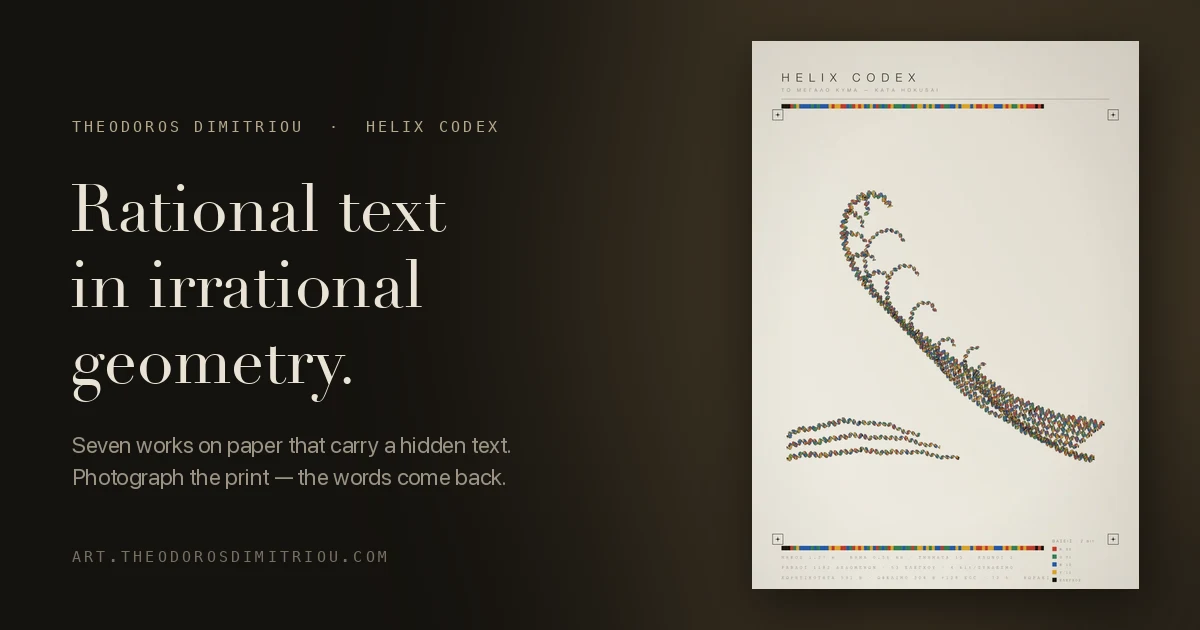
From the age of five until fourteen I went to art school. I won prizes before I understood what they meant. Then computers came, and the painting stayed behind. No ceremony, no decision, just the quiet idea that I would pick it up again some time.
Some time turned out to be a long interval. Decades of code later, I've opened Helix Codex: seven works on paper, and the first time in all those years that I've put my name on a piece of art.
Every work is read three times
From afar, you see a form. A wave, a spiral, a sunflower, a labyrinth. None of it is drawn by hand: every shape comes from a few lines of mathematics. The same text and the same seed give the same sheet, every time. My hand is in the choosing, not in the tracing.
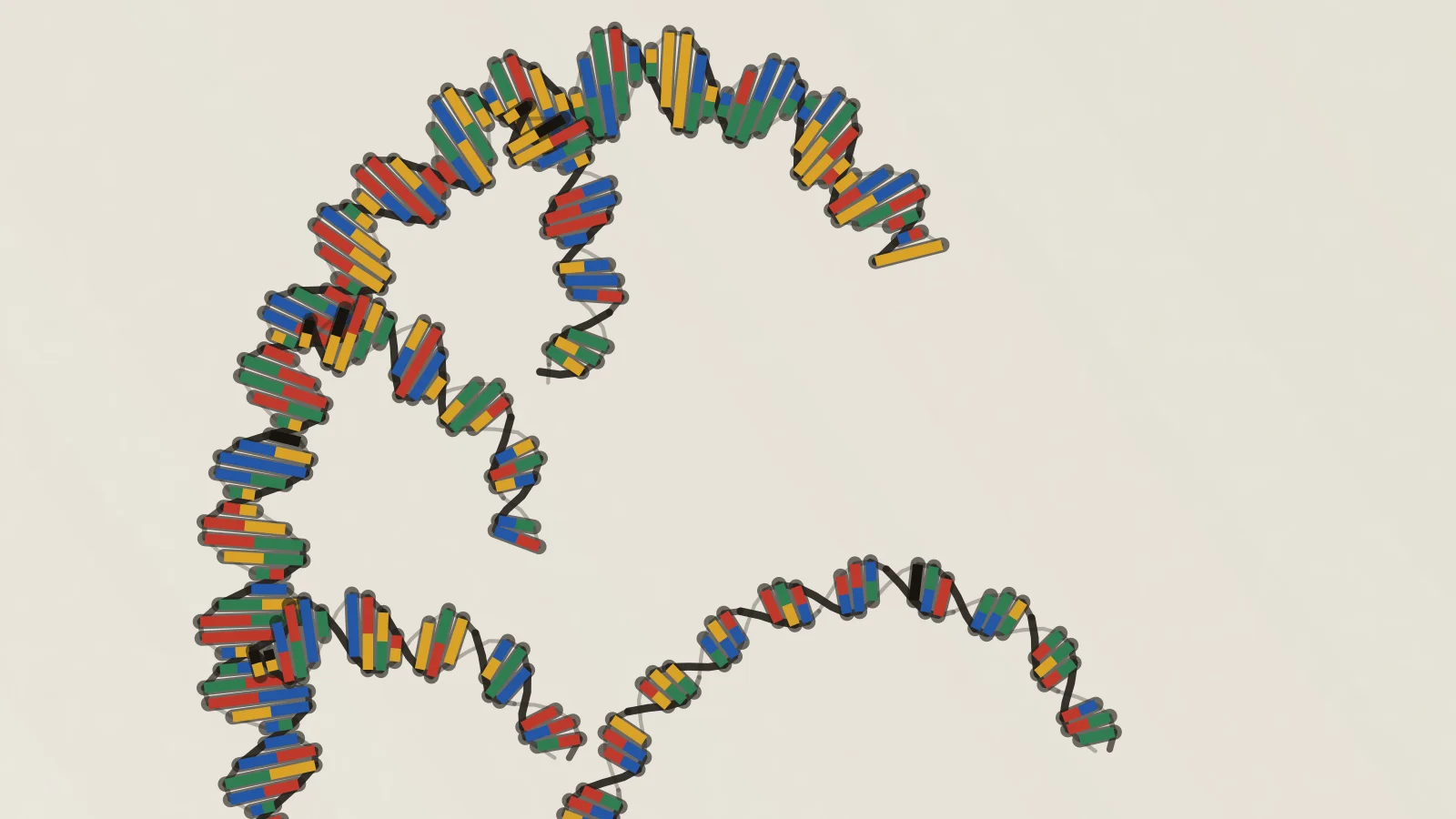
Up close, the line turns out to be a double helix, and every rung carries a colour. Red, green, blue, yellow: four colours, two bits each. Come down to a fraction of a millimetre and you are looking at the atoms of the letters.
With the reader, the text comes back. Photograph the whole sheet with a free little app on your phone and the hidden words return, letter for letter. No account, no network, no key but the page itself.
“Ithaka”, for example, carries the first stanza of Cavafy's poem: 52 words, 432 bytes, along a line 1.37 metres long folded into Hokusai's wave, in 1,182 rungs. Hold it at arm's length and it's a print. Point a phone at it and it's a poem.
Seven works, seven texts
Each text belongs to the form that hides it. The wave carries the journey to Ithaka. The river carries Heraclitus, who never stepped in the same one twice. The sunflower carries the golden angle that builds it. Sappho is in the garden, Apollodorus in the labyrinth.
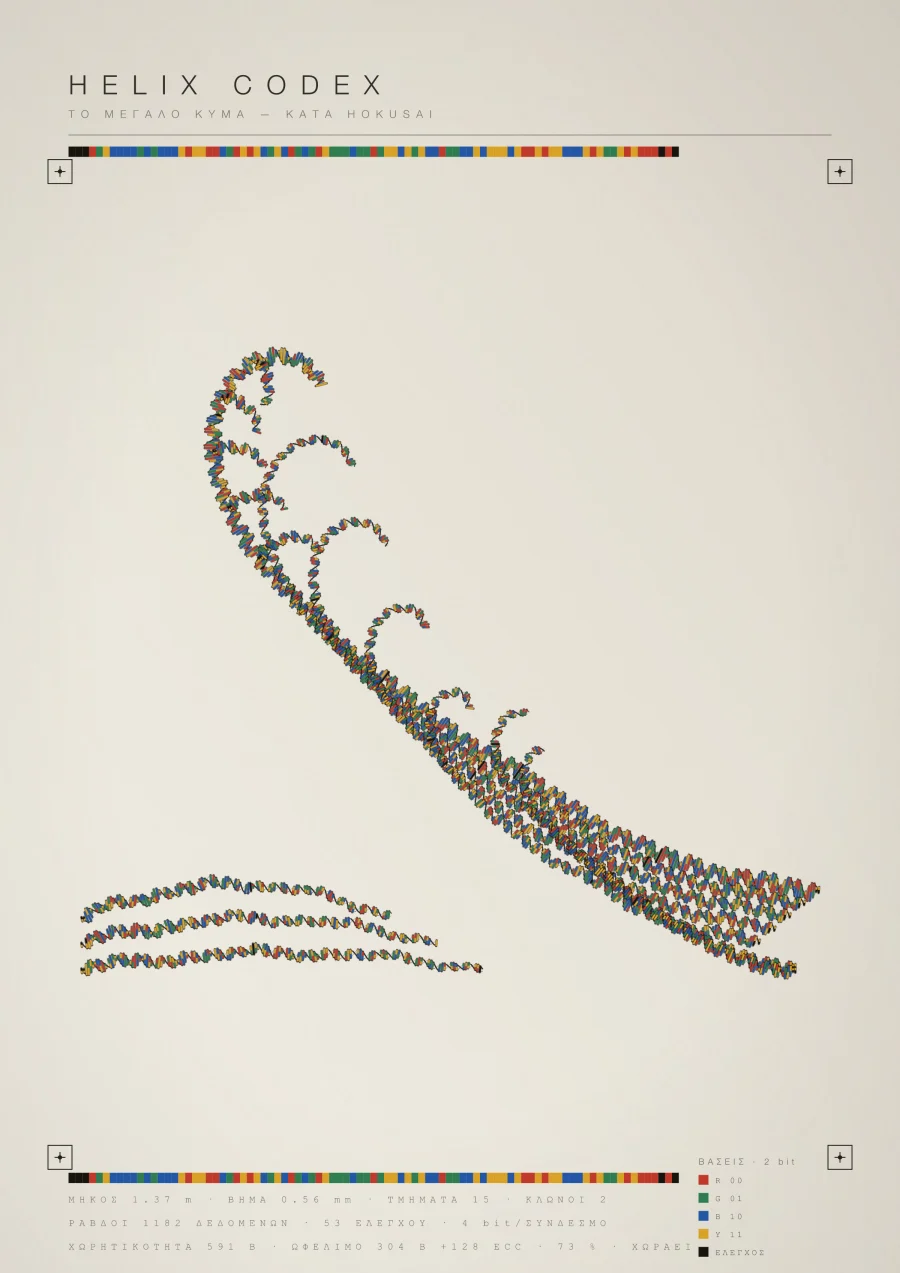 Ithaka
C. P. Cavafy · the great wave
Ithaka
C. P. Cavafy · the great wave
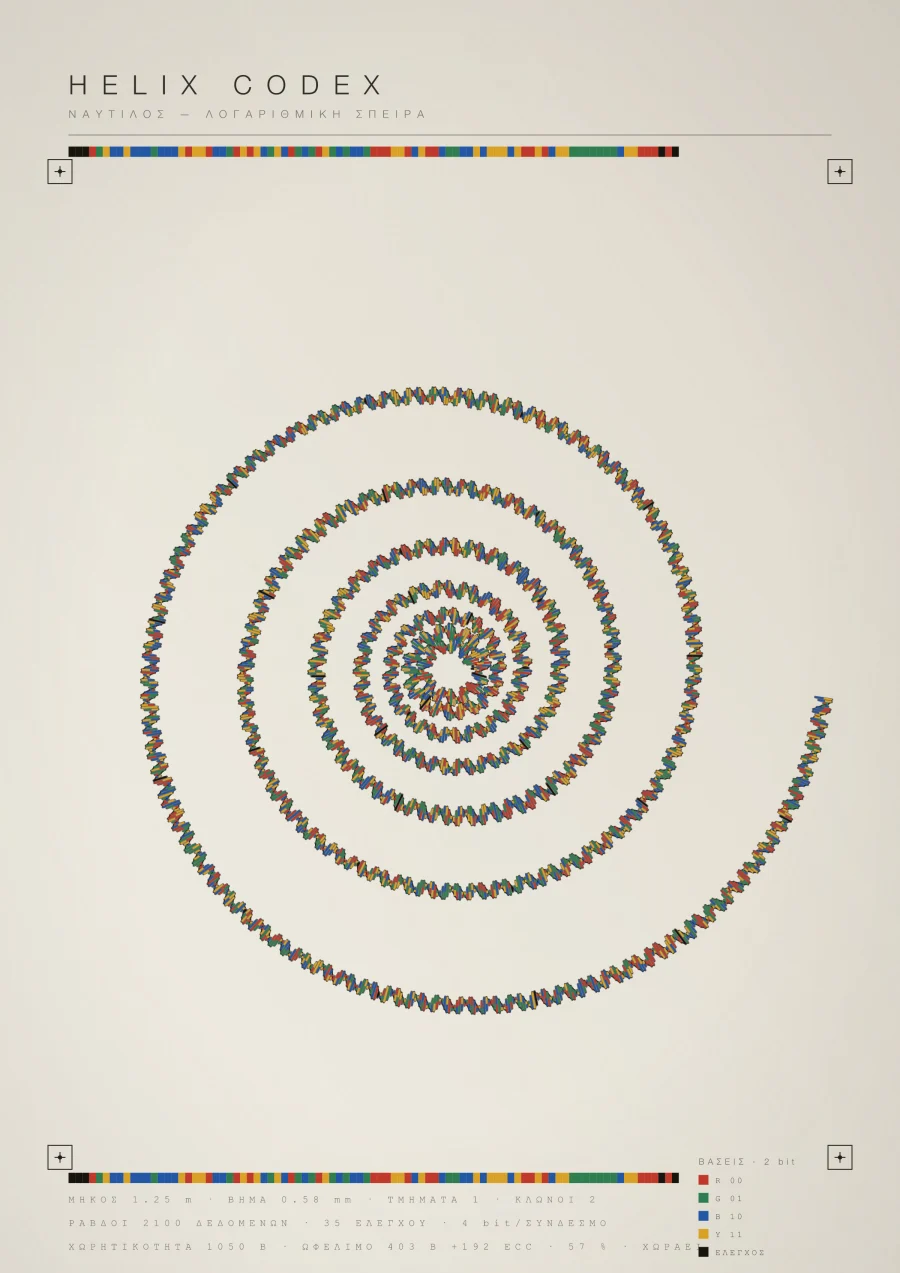 The Way Back
my own text · logarithmic spiral
The Way Back
my own text · logarithmic spiral
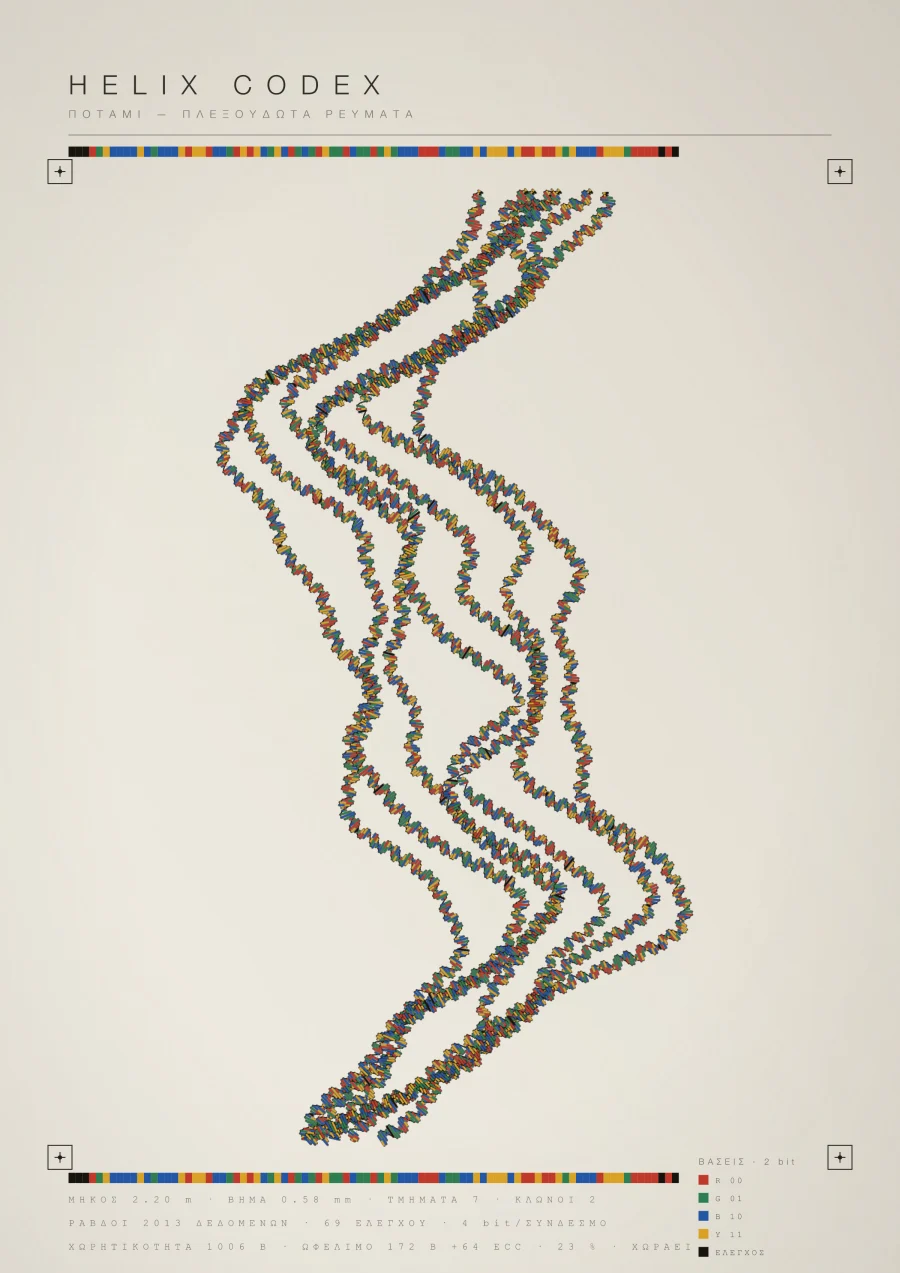 River
Heraclitus · braided riverbeds
River
Heraclitus · braided riverbeds
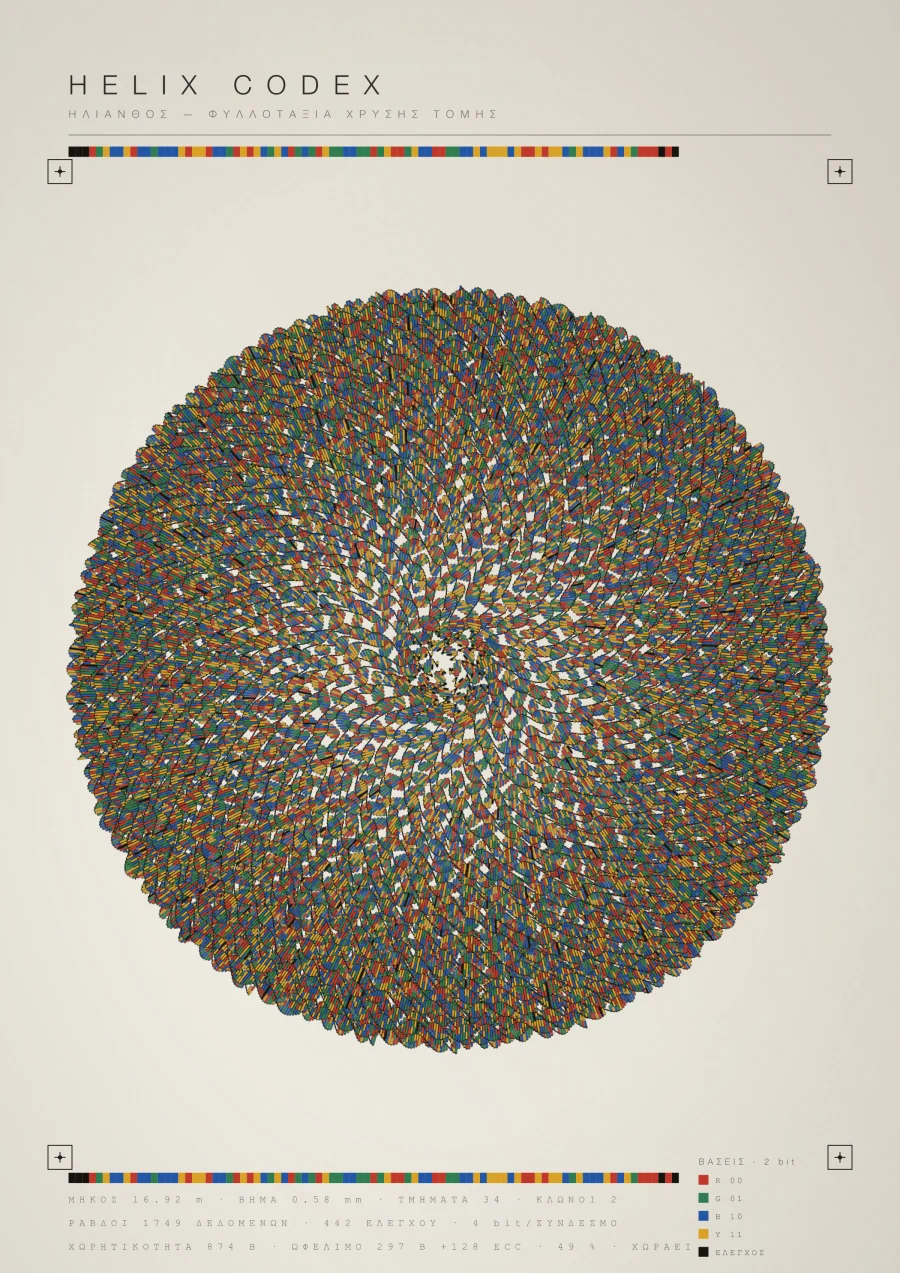 Heliotrope
phyllotaxis · the golden angle
Heliotrope
phyllotaxis · the golden angle
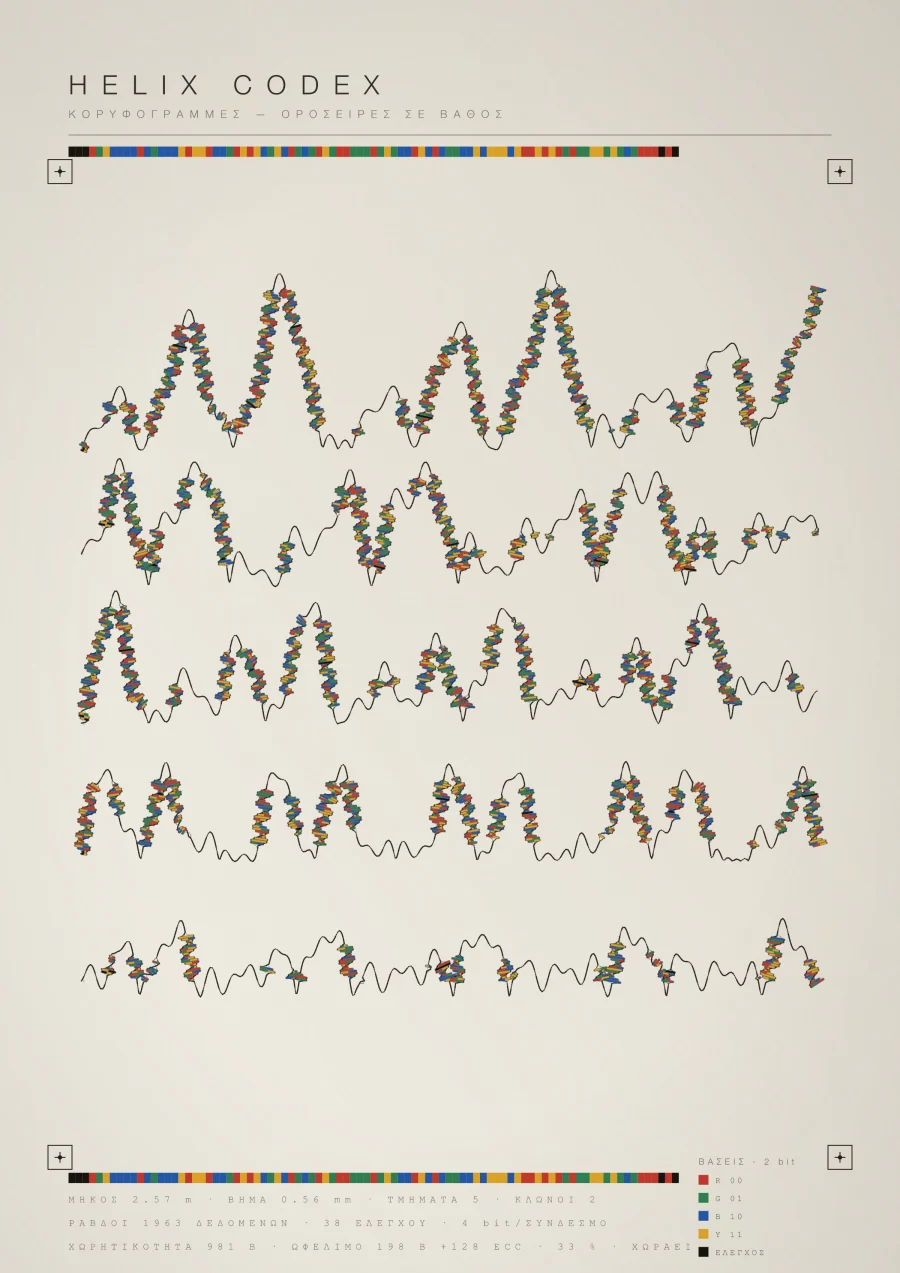 Ridgeline
a folk song · ridges in depth
Ridgeline
a folk song · ridges in depth
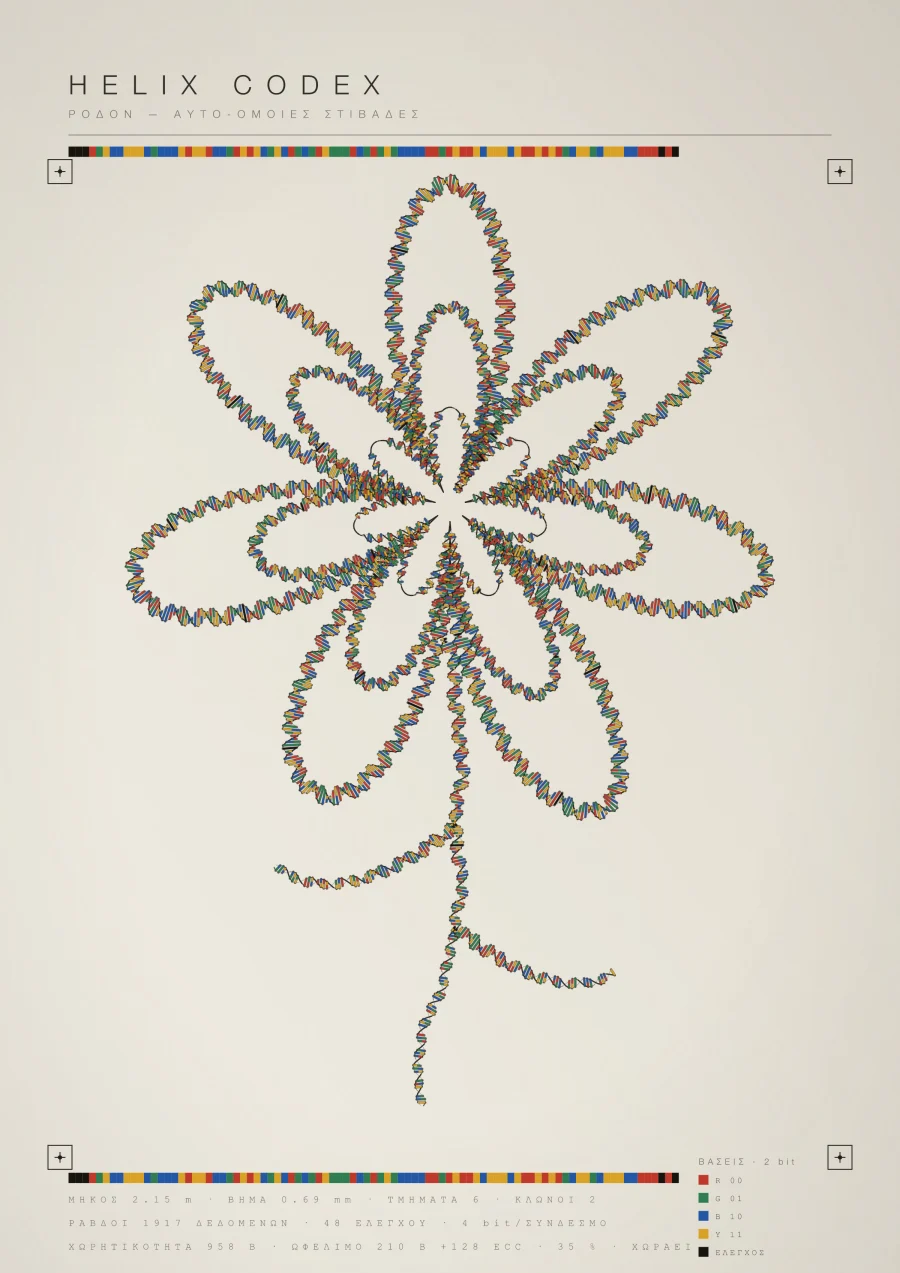 Garden
Sappho · petals in three layers
Garden
Sappho · petals in three layers
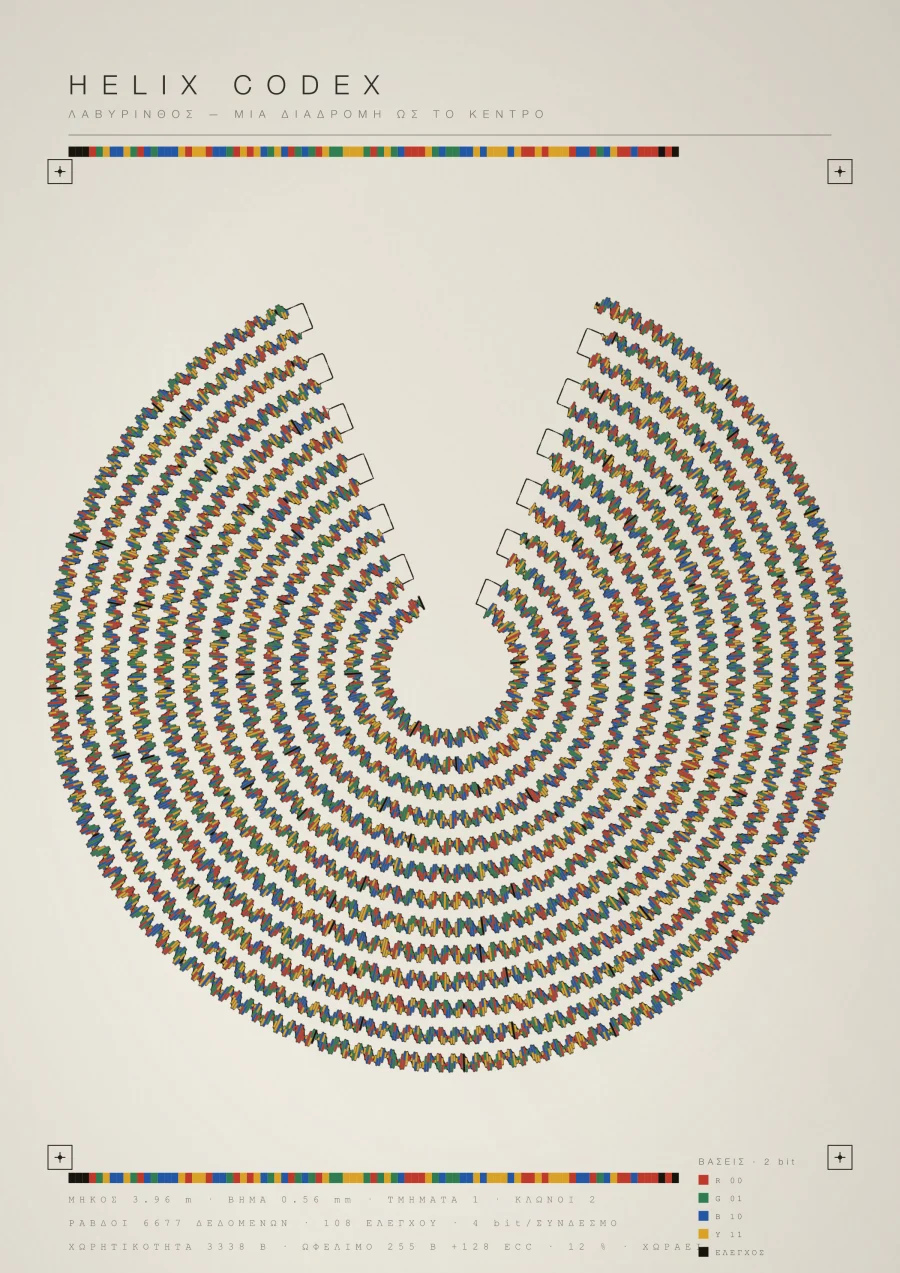 Labyrinth
Apollodorus · rings with a gate
Labyrinth
Apollodorus · rings with a gate
One of them is different. “The Way Back” is the only text in the series that is mine, hidden in a logarithmic spiral, the curve that grows without changing shape. You move away and remain the same. The about page of the site has no biography; it has this work instead, and the story at the top of this post is what it says.
Rational text in irrational geometry
This is the part that still gives me goosebumps. Every sheet is A4, and A4 is 1 : √2, the only shape that survives being cut in half: fold it and you get two copies of itself. The ancient Greeks had a word for √2. They called it ἄλογον: without ratio, unspeakable. The diagonal of a square that no common measure can reach. It's the discovery that broke the Pythagoreans, and legend says the sea took the man who proved it.
So my paper is the one shape that cannot be measured by itself, and I write words on it. In Greek the same words mean “expressible number” and “spoken word”, and that's not a metaphor: it's two literal readings sharing one line. The site tells the whole story, twenty-five centuries in nine steps, from Croton to Watson and Crick to this page.
Why paper, in 2026?
It could have stayed a file. It doesn't. A file needs someone to open it with the right program; a printed sheet needs only light. The format is built to outlive servers, mine included.
The engineering is the part of me that never left. Four corner marks fix the perspective, so a photo taken at an angle becomes a flat sheet again. A colour legend calibrates each camera, because every phone sees red a little differently. A strip along the top carries the recipe of the geometry. And error correction from the same family used on compact discs repairs what a shadow, a smudge or a scratch destroyed. The reader is a small web app that installs on your home screen and works offline; your photos never leave the phone, because there's no server to send them to.
The full engineering story, from the Reed-Solomon codes to the WebAssembly reader, is in the Helix Codex case study in my portfolio.
That's the road back I found. I didn't return with a brush. I returned by the road I learned in between.
Take one home
- Try it free: download the sample sheet, print it at 100 % on A4, open the reader and watch 2,077 hidden characters come back.
- Prints: archival pigment on cotton paper, signed and numbered, editions of 25. A4 €120, A3 €190, A2 €320. Every print is read back with the reader before it ships; if it doesn't read, it doesn't leave. See the prints.
- Commissions: your text, in a geometry we choose together. Wedding vows, a poem, a family history, the letter you never sent. The words go inside the work, not beside it. Commission a piece.
If you walk through the room, scroll slowly. And if one of the works stays with you, tell me which. I waited a long time to hear that.
Share this post
Help others discover this content by sharing it on your favorite social networks!
Subscribe to my Newsletter
Stay informed with the latest updates and insights.
We'll never share your email with anyone else.
admin
Senior Fullstack Developer
Thank you for reading my blog post! If you found it valuable, please consider sharing it with your network. Want to discuss your project or need web development help? Book a consultation with me, or maybe even buy me a coffee ☕️ with the links below. Your support goes well beyond a coffee drink. Its a motivator to keep writing and creating useful content.
Related Posts
All essays →- Sep 29, 2026
I made a board game: Psifides, an Aegean island built tile by tile
- Sep 24, 2026
Spectators at backgammon and chess, table chat that reaches your opponent, birimba done right
- Sep 23, 2026
AstroBaaS is open source: a self-hosted, MCP-ready CMS and backend on Astro
- Jul 17, 2026
askTheodor is live — I hired myself an AI workforce