Spectators at backgammon and chess, table chat that reaches your opponent, birimba done right
The arcades and internet cafés of our youth were never about the games. They were about the friend standing behind you. Connect Cafe is my way of keeping those friendships alive, and this week it got spectators and table chat.

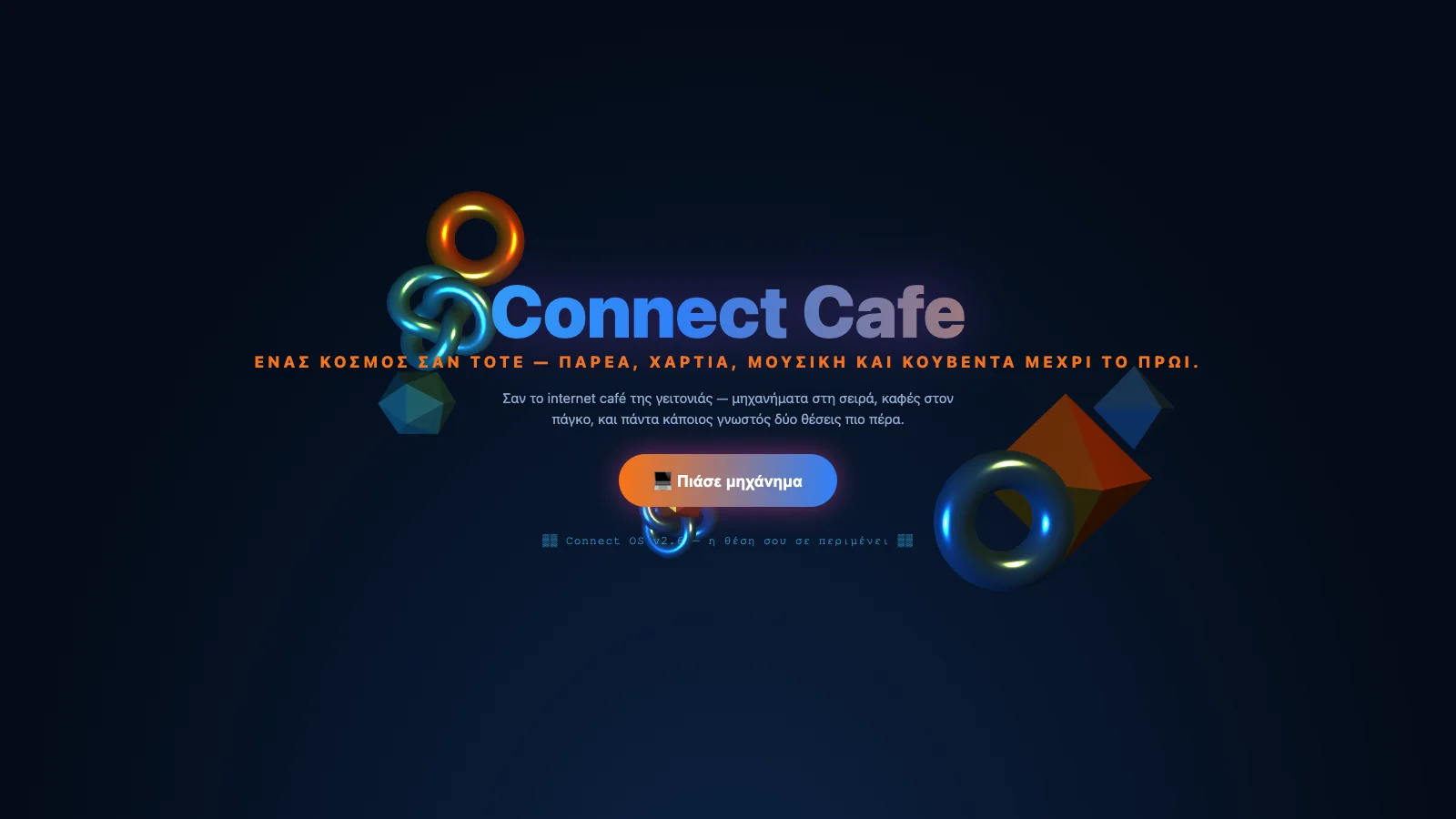
If you grew up in Greece in the '90s, you know the smell. Cigarette smoke, warm machines, an iced frappé sweating on the counter. The neighbourhood arcade, and a little later the first internet cafés, were where we lived after school. We saved coins all day for an hour in there, and the hour always ran out faster than it should have.
Nobody ever played alone. There was always someone standing behind you. Watching, commenting, shouting "not that one, the other one!" and waiting for their turn. If you lost, the whole neighbourhood knew by evening. If you won, the same. The game was the excuse. What mattered was that we were there, all of us, together.
Why I'm building it
The years went by the way they do for everyone. University in another city, military service, jobs, some of us moved abroad, then weddings and kids. The group drifted apart without anyone deciding it should. I still have numbers in my phone for people I used to see every day, and I don't even know if they're still theirs. Every time I think about it, I miss them.
Connect Cafe is my way of keeping those friendships alive. And, if I'm lucky, of finding people I lost touch with years ago. Because a "how are you?" after fifteen years of silence is hard to send. A "fancy a game of backgammon tonight?" is much easier. And somewhere in the middle of a game, between two rolls of the dice, the conversation starts on its own. Just like back then.
That's why, over the last few days, I built exactly the pieces that were missing to make it feel like our old hangouts: the friend who sits next to you and watches, and the chat that actually reaches the other side of the table.
Backgammon and chess: pull up a chair and watch
Just like back then, half the people don't play. They sit next to the table and watch. Now that works here too.
When you open a table, against a person or the bot, you'll see a “👁 Public” checkbox. It decides whether others may pull up a chair. Anyone who wants to watch clicks “👁 See tables” or “👁 See games” and sees the board live, move by move, along with the players' chat. But they can't talk and they can't play. You watch, you hold your tongue, and you save the advice for later.
Players see how many people are watching, e.g. “👁 2 spectators”. And if you'd rather have some peace, open a 🔒 private table, which never shows up for spectators.
Table chat now reaches the other side
In birimba, backgammon and chess, whatever you type at the table is now seen by your opponent, and by any spectators. Until now the words got lost in the smoke. Your opponent wasn't giving you the cold shoulder, they just couldn't hear you. Now they can. For me this is the most important change of all, because the conversation was always the reason we sat down. Just mind the banter.
A few more things, for the serious players
Backgammon (Portes, Plakoto, Fevga). In Plakoto, a player who has pinned a checker can now move off it or stack more checkers on that point, as in real backgammon. If both mother checkers get pinned, the game is a draw, as the rule says. “Zarifis”, our bot, has learned to play properly: it builds points, looks after its exposed checkers and knows when to trap the mother checker. And the window now shows which variant you're playing and whether your checkers are 🟣 or 🔵.
Chess. If your connection drops during a timed game, the clock shows the right time when you come back.
Birimba. A 2 in its natural place in a run (e.g. A-2-3 of hearts) counts as a normal card. Nobody can “empty” their hand and cut the round short unless they're allowed to close. The bots, as partners or opponents, play proper birimba. If whoever opened a table leaves while it's still waiting for players, the table passes to the next player, so nobody is left staring at each other. And big birimbas show how many cards they hold, so you don't have to count on your fingers.
Your seat is here
I don't know if a website can bring back those afternoons. Probably not. But it can put us back at the same table, and that's already a lot.
If you're someone from those years and you're reading this, drop by connect.webcafe.gr. Open a table, or just pull up a chair. I'd really love to see you.
Share this post
Help others discover this content by sharing it on your favorite social networks!
Subscribe to my Newsletter
Stay informed with the latest updates and insights.
We'll never share your email with anyone else.
admin
Senior Fullstack Developer
Thank you for reading my blog post! If you found it valuable, please consider sharing it with your network. Want to discuss your project or need web development help? Book a consultation with me, or maybe even buy me a coffee ☕️ with the links below. Your support goes well beyond a coffee drink. Its a motivator to keep writing and creating useful content.
Related Posts
All essays →- Sep 23, 2026
AstroBaaS is open source: a self-hosted, MCP-ready CMS and backend on Astro
- Jul 17, 2026
askTheodor is live — I hired myself an AI workforce
- Jan 28, 2026
Moltbot: The Viral 'Claude with Hands' (Formerly Clawdbot)
- Jan 25, 2026
Nvidia's AI Empire: How Jensen Huang Built the Future of Computing